
Pilates for Parkinson’s Palm Springs CA | The Fitness Edge
Pilates Reformer Classes For Parkinson's
It is a well-documented fact that exercise has been shown to slow the progress of many symptoms of Parkinson’s disease. The frequency is usually suggested at 3 ½ hours of aerobic exercise per week. The type of exercise is generally not specified.
Although there exist other exercise programs for persons with Parkinson’s, the core tenets, methods, and type of work done in Pilates offers the Parkinson’s sufferer a safe, intense, and efficient system of exercise that addresses many of the specific effects of the disease.
More importantly, it is a malleable system that allows for the breaking down of complex movement for those with limited physical capacity and the development of complex and strenuous exercises as the physical limitations—particularly coordination and stamina—improve.
What Pilates can offer is a clear, efficient, and safe progressive program that addresses balance, strength, coordination, and cardio.
Pilates is an exercise program that can be practiced every day, which is necessary for a Parkinson’s patient to improve and maintain his or her physical self.
Aerobic exercise is an important component of maintaining health and furthering physical progress but difficult because with many aerobic activities, like running, risk of falling is high. Pilates provides an ideal method of increasing heart rate while lying on the back.
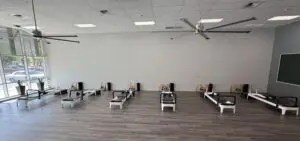
Our classes are small, a maximum of 6 students.
Classes are Monday – Tuesday – Wednesday at 1:00 pm
Take Your First Class for Free!
Benefits of Pilates for Persons with Parkinson's
Tremor
Pilates uses the resistance of springs with handles or straps so the arms and legs are stabilized.
Bradykinesias
The muscle work in Pilates is done at a deliberately slow pace that can be sped up when well established.
Lack of Coordination
Pilates works specifically to create awareness of how muscles work together to achieve efficient body motion.
Balance
Much of the work in Pilates is done lying fully supported on the Reformer where one can stretch, coordinate, and strengthen their muscles safely.
Multi-Tasking
A core principle of Pilates is mind-body connection with many of the exercises using different muscle groups in complex patterns.
Rigidity
In a Pilates session the body is almost in constant movement helping to alleviate at least some of problems caused by rigidity.
Posture
In all exercises, Pilates continually works on the strengthening and control of the postural muscles.
Freezing
Pilates has the individual repeat movements in a precise manner guided by cues from the instructor.

Meet Our Instructor Ron
As a performer, musician and teacher, I was diagnosed with Parkinson's more than 10 years ago. I have been a long-time student of Iyengar yoga and have studied Pilates daily over the last five years. I believe that Pilates has had a profound effect on significantly reducing my Parkinson's symptoms as a function of its structured mind-body connection and precise methodology.
These benefits led me to undertake completion of a course in Pilates Teacher Training with the desire to share this knowledge and experience with those within the Parkinson's community.